Codersera


16 min to read
SaaS Product Development From Scratch in 2026: A Complete A–Z Guide
Learn how to build a SaaS product from scratch in 2026: idea validation, architecture, pricing, testing, benchmarks, launch strategy, and growth tips.

More than 80% of businesses already use at least one SaaS application, and by the end of 2024, an estimated 99% of companies are expected to rely on SaaS tools in some way. The global SaaS market is forecast to reach around 400 billion dollars in 2026 and continue growing strongly through 2029. In simple words: almost every business is becoming a SaaS customer.
That sounds like a dream opportunity if you want to build your own SaaS product. But there is a hard side: competition and growth pressure. A famous McKinsey analysis, often quoted in the SaaS world, shows that software companies growing “only” 20% per year have about a 92% chance of disappearing in a few years – which means only roughly 8% survive. In SaaS, slow growth is dangerous.
What Is a SaaS Product? (Quick Refresher)
A SaaS (Software as a Service) product is software:
- Hosted in the cloud (not installed on the customer’s own servers)
- Accessed through the internet (usually via browser or mobile app)
- Sold on a subscription or usage basis (monthly/annual plans)
- Continuously updated by the vendor without the customer reinstalling anything
SaaS vs Traditional Software vs Custom Solutions
Here is a quick comparison to clarify where SaaS sits:
| Model | How it’s delivered | Pricing style | Pros for customers | Cons for customers |
|---|---|---|---|---|
| SaaS | Hosted by vendor, accessed via internet | Subscription / usage-based | Low upfront cost, fast to start, always updated | Recurring cost; data & uptime depend on vendor |
| On‑premise software | Installed on customer’s own servers | Large license + maintenance | Full control over data, often customizable | High upfront, upgrades painful, needs IT team |
| Custom-built solution | Built specifically for one customer | Project fee + support | Exact fit to processes, full control | Very expensive, slow to build, tech debt risk |
What is the unique selling point (USP) of the SaaS model itself?
- Speed – customers can start using it in minutes or days, not months
- Continuous value – new features and fixes appear automatically
- Lower risk – cancel anytime if it does not work; less CAPEX, more OPEX
- Network & data effects – vendors can learn from usage across many customers, improve faster, and build AI features powered by aggregated (anonymized) data
Your own product’s USP will live on top of this: niche, workflow, AI features, integrations, etc.
The SaaS Product Development Journey: A–Z Overview
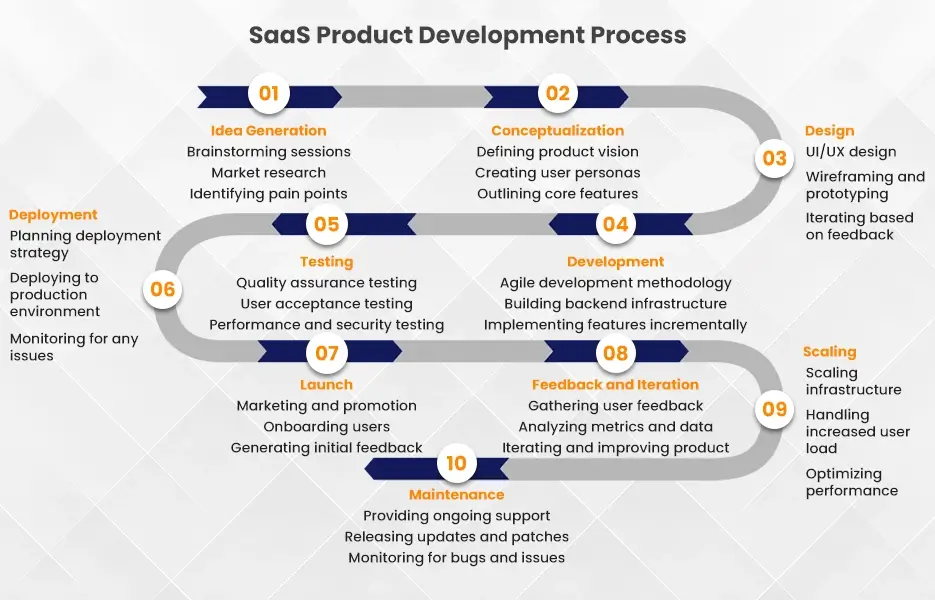
Before diving into details, here is the full journey from idea to launch:
- Discover & validate the idea
- Define the business model and pricing
- Shape the product strategy and roadmap (MVP first)
- Design the UX and key user flows
- Choose architecture and tech stack
- Build the product with a modern development process
- Test thoroughly (functional, performance, security, usability)
- Run a private beta and iterate
- Prepare go‑to‑market (GTM), launch, and measure
- Optimize based on benchmarks and grow
Quick Comparison Chart: Stages, Goals and Outputs
| Stage | Main Goal | Key Outputs |
|---|---|---|
| Idea & Validation | Confirm real problem & demand | Problem statement, ICP, early interest list |
| Business Model & Pricing | Make money in a sustainable way | Pricing model, sample packages, basic financial model |
| Product Strategy & Roadmap | Decide what to build first (MVP) | Feature list, MVP spec, prioritized backlog |
| UX & Design | Make product usable and lovable | Wireframes, clickable prototype |
| Architecture & Stack | Make it scalable & secure | System diagram, tech stack choices, data model |
| Development | Turn plan into working code | Deployed MVP (staging & production) |
| Testing | Ensure quality, speed, and safety | Test plan, automated test suite, performance reports |
| Beta & Iteration | Validate in real conditions | Usage feedback, churn signals, refined roadmap |
| Launch & GTM | Acquire paying customers | Launch assets, campaigns, distribution channels |
| Optimization & Growth | Improve metrics against benchmarks | KPI dashboard, experiment backlog, growth roadmap |
The rest of the article walks through each stage with practical guidance, examples, and benchmarks.
Step 1: From Idea to Validated Problem
1.1 Start with a Pain, Not a Feature
Strong SaaS products usually start from a clear, painful, and frequent problem rather than a cool technology. Think in terms of jobs to be done: “What job is your customer trying to get done that is painful today?”
Good starting prompts:
- What do people in this role do on spreadsheets or email that is messy?
- Where do teams complain about “manual work”?
- Where are there compliance or audit risks that scare managers?
- Which tasks get delayed because different tools do not talk to each other?
1.2 Define Your Ideal Customer Profile (ICP)
Be specific:
- Company size (freelancer, SMB, mid‑market, enterprise)
- Industry (e.g., healthcare SaaS, fintech SaaS, logistics SaaS)
- Main buyer role (e.g., Head of Operations, CFO, HR Director)
- Geography (because pricing, regulations, tax rules vary)
A focused ICP gives you clearer product decisions, pricing, and messaging.
1.3 Do Lightweight but Real Validation
Validation is about evidence, not opinions. Do at least:
- Customer interviews
- 10–20 calls with people in your ICP
- Ask about their current workflow, tools, costs, and frustrations
- Avoid pitching too early; listen to how they describe the problem
- Competitor scan
- Look at G2, Capterra, and alternative‑to pages for existing tools
- Read 1‑star and 3‑star reviews to see what people dislike
- If market is crowded, your USP must be very clear (niche, workflow, integrations, price, or AI features)
- Value and willingness‑to‑pay signals
- Ask how much time or money the problem costs per month
- Ask what they pay today (tools, internal labor, consultants)
- Soft pre‑commit: “If we built X that solves Y, would you pay around Z per month?”
A strong sign of validation: people ask “When can I try it?” and are willing to join a waitlist.
Step 2: Business Model and Pricing Strategy
SaaS economics matter a lot because your growth and survival depend on them.
2.1 Common SaaS Pricing Models
- Per‑user (seat‑based) – e.g., 10 USD/month per user
- Per‑account / per company – flat rate (useful for very small teams)
- Usage‑based – pay for API calls, storage, messages, etc.
- Feature‑tiered – Basic / Pro / Enterprise tiers with more features at higher prices
- Hybrid – base subscription + usage (common for developer tools and infrastructure)
Usage‑based and hybrid models are increasingly popular, especially combined with AI features, because they align cost with value and can scale better.
2.2 Example Pricing Table (Hypothetical)
Below is a sample pricing structure for a B2B SaaS targeting small and mid‑sized teams. This is only an example, not a market benchmark:
| Plan | Target customer | Price (example) | Key limits/features |
|---|---|---|---|
| Starter | Freelancers & micro‑SMB | 15 USD/user/month | Up to 3 users, core features, email support |
| Growth | Small teams | 29 USD/user/month | Up to 25 users, integrations, priority support |
| Scale | Mid‑market | 59 USD/user/month | Unlimited users, SSO, advanced analytics, SLA |
| Enterprise | Large orgs | Custom (annual deal) | Custom limits, dedicated CSM, security add‑ons |
This type of tiering allows you to:
- Make it easy to start (Starter is affordable, low risk)
- Encourage upgrades when teams grow (Growth, Scale)
- Capture large value with custom enterprise pricing
2.3 SaaS Financial Benchmarks to Keep in Mind
Some important industry benchmarks (especially for B2B SaaS):
- Gross Margin
- Healthy SaaS businesses often have >75% gross margin on software subscriptions; top performers aim for 80%+.
- Churn & Retention
- Average SaaS churn is often in the range of 10% annually, though it varies by segment; some sources put SMB SaaS churn at 5–7% monthly and enterprise churn at 1–2% monthly.
- Median net revenue retention (NRR) across SaaS companies is about 102%, meaning upsells slightly exceed churn, while gross revenue retention (GRR) median is around 91%.
- LTV:CAC (Customer Lifetime Value to Customer Acquisition Cost)
- A common target is LTV:CAC of at least 3:1, with a median around 3.2:1 for B2B SaaS.
- Gross Margin & CAC payback
- 75–80%+ gross margin on subscriptions and a CAC payback within 12–24 months are considered strong in many 2024–2025 benchmark reports.
These numbers are not strict rules, but they help you judge if your model is on a healthy track.
Step 3: Product Strategy and Roadmap (Designing the MVP)
3.1 Define Your Core Value Proposition
A simple way to express it:
For [ICP], who struggle with [Problem], our product is a [Category] that helps them [Key outcome] by [Main mechanism]. Unlike [Main competitor], it [USP].
Example:
For small HR teams, who struggle with tracking candidate feedback in spreadsheets, our product is a recruitment workflow SaaS that centralizes messages and scorecards in one place. Unlike generic ATS systems, it focuses on interview collaboration and feedback quality.
3.2 Decide What Goes into the MVP
An MVP is not a cheap, buggy product. It is a narrow but excellent version that:
- Solves a specific problem end‑to‑end for a narrow ICP
- Is reliable and fast enough to be used in real work
- Is missing many “nice‑to‑have” features (reports, templates, etc.) you can add later
Use a simple prioritization framework:
- Must‑have – without this, the product is useless (e.g., sign‑in, core workflow)
- Should‑have – important but you can launch without them
- Could‑have – nice extras (e.g., themes, minor integrations)
- Won’t‑have (yet) – explicitly excluded from MVP to stay focused
3.3 Roadmap Example
- MVP (3–4 months): Single core flow, 1–2 integrations, basic analytics, email login, roles (admin/user)
- Post‑MVP (next 3–6 months): More integrations, improved reporting, notifications, basic AI assistance
- V2 (beyond 6–9 months): Advanced AI features, multi‑language support, marketplace or API platform
Keep the roadmap flexible. Real user feedback will change your priorities.
Step 4: UX, Flows and Design
Even a technically strong SaaS product will fail if people find it confusing.
4.1 Map Key User Journeys
At minimum, design these flows:
- Sign‑up and onboarding
- First key action (e.g., create a project, connect an integration)
- Daily/weekly repeat actions (the main workflow)
- Collaboration flows (sharing, assigning tasks, comments)
- Billing and plan upgrade/downgrade
4.2 Low‑Fidelity to High‑Fidelity
- Start with sketched wireframes to discuss structure and layout
- Create a clickable prototype using Figma, Sketch, or similar tools
- Test the prototype with 5–10 target users; fix confusing flows before writing code
Clear UX saves a lot of development time later and improves activation and retention.
Step 5: Architecture and Tech Stack (Building for Scale)
The SaaS market is expected to reach hundreds of billions in revenue by the end of this decade, driven heavily by AI‑powered Saas services and global adoption. To play in this space, even a small product needs a robust technical foundation.
5.1 Multi‑Tenant vs Single‑Tenant
Most early SaaS products use a multi‑tenant architecture:
- All customers share the same application and databases (with strict data separation via tenant IDs)
- Easier to deploy, maintain, and update
- Better cost efficiency and scalability
Single‑tenant (separate instances per customer) is more common for highly regulated industries or very large enterprise deals but is slower and more expensive to manage.
5.2 Typical Modern SaaS Stack (Example)
- Frontend: React, Vue, or Angular (SPA or micro‑frontends)
- Backend: Node.js, Python (Django/FastAPI), Ruby on Rails, Java/Spring, or Go
- Database: PostgreSQL/MySQL for relational data; Redis for caching; optionally a document DB (MongoDB)
- Infrastructure: AWS / GCP / Azure; containerized with Docker; orchestrated via Kubernetes or managed PaaS
- Authentication: OAuth 2.0 / OpenID Connect; JWT; SSO (SAML) for enterprise
- DevOps: GitHub/GitLab CI, Terraform for IaC, monitoring via Prometheus/Grafana, Datadog, or similar
- Security & compliance basics: TLS everywhere, encrypted at rest, logging, least‑privilege access, secrets management (e.g., AWS Secrets Manager)
Your exact choices depend on your team’s skills, but the principles are the same: scalable, secure, observable, and automatable.
Step 6: Development Process – How to Build the SaaS Product
6.1 Work in Small, Testable Iterations
Adopt an agile approach:
- 1–2 week sprints with clearly defined goals
- Groomed backlog aligned with roadmap
- Regular demos to stakeholders or early users
- Continuous integration and frequent releases to staging (and later production)
6.2 Code Quality Practices
- Code reviews for every pull request
- Shared coding standards and linters (ESLint, Prettier, etc.)
- Documentation for APIs and main modules
- Feature flags to roll out new functionality gradually
This makes later testing, debugging, and scaling much easier.
Step 7: Testing Your SaaS Product (Detailed)
Testing is not a nice‑to‑have. It is central to SaaS success because your users access the product 24/7 and expect high reliability.
7.1 Types of Tests You Should Implement
1. Unit Tests
- Test individual functions or classes
- Goal: catch logic issues early and make refactoring safe
- Example: “Calculate monthly invoice total with discounts and taxes”
2. Integration Tests
- Test how modules work together (e.g., backend + database, backend + third‑party API)
- Example: “Creating a new project stores a record in DB and triggers email”
3. End‑to‑End (E2E) Tests
- Simulate real user workflows through the UI using tools like Cypress or Playwright
- Example scenarios:
- Sign‑up → Confirm email → Login → Create first item
- Admin invites a teammate and assigns a role
- User upgrades plan and billing updates successfully
4. Regression Tests
- Make sure new changes do not break old features
- Usually automated and run in CI on every commit
5. Performance & Load Tests
- Use tools like JMeter, k6, or Locust to test how the app behaves under load
- Sample performance test scenarios:
- 1,000 concurrent users logging in and loading dashboards
- Batch operations (e.g., importing 10,000 records)
- Track metrics:
- Response time (p95 and p99)
- Error rate
- CPU/memory usage
- Database query performance
6. Security Testing
- Static Application Security Testing (SAST): scan code for known security issues
- Dynamic Application Security Testing (DAST): test running app for vulnerabilities
- Penetration tests (manual, often by third parties) for higher‑risk apps
- Basic checks:
- Proper authentication and session management
- Input validation and protection against XSS, SQL injection
- Correct access control for multi‑tenant data isolation
7. Usability Testing
- Observe 5–10 users as they try to complete tasks:
- “Set up your first project”
- “Invite a teammate and assign a role”
- Note confusion, misclicks, and drop‑off points; adjust UX accordingly
7.2 Building a Test Strategy (Example)
| Test level | Goal | Who owns it | Automation level |
|---|---|---|---|
| Unit | Correctness of small pieces | Developers | High (run on every commit) |
| Integration | Systems talk correctly | Developers / QA | Medium–High |
| E2E | Critical user flows work | QA / Developers | Medium (nightly, pre‑release) |
| Performance | Handles expected load | QA / DevOps | Medium (before big releases) |
| Security | Basic safety covered | Security / DevOps | Mixed (tools + manual) |
| Usability | Easy to use & understand | Product / UX | Manual (per major feature) |
Good SaaS teams aim to automate as much as possible and keep manual testing focused on exploratory and usability checks.
Step 8: Private Beta, Feedback Loops, and Iteration
Before a big public launch, run a private beta with a small group of real users.
8.1 Private Beta Goals
- Validate that the product solves the problem in real workflows
- Discover hidden edge cases and bugs
- Measure early usage and satisfaction (activation rate, time‑to‑value, NPS)
8.2 Running the Beta
- Invite 10–50 companies from your interview list
- Offer free access for a fixed period or early‑adopter discount
- Provide high‑touch support (Slack group, weekly calls)
- Collect structured feedback:
- What did you like most / least?
- What almost made you stop using it?
- Which feature would you miss most if removed?
Use this feedback to refine your roadmap before scaling.
Step 9: Launch Strategy and Go‑To‑Market (GTM)
With a validated product, you need a plan to get customers.
9.1 Choose a GTM Motion
Common GTM models for SaaS:
- Product‑led growth (PLG)
- Free trial or freemium; user onboards themselves
- Upgrade path inside the product (paywalls, usage limits)
- Sales‑led
- Demo requests, SDR/AE teams, custom proposals
- Better for high‑ACV (Annual Contract Value) deals
- Hybrid
- PLG at smaller tiers + sales assist for larger accounts
Your motion should match your pricing and ICP. Low‑priced tools work best with PLG; high‑priced enterprise tools need sales.
9.2 Launch Checklist
Pre‑launch
- Landing page with clear value proposition and visual demo
- Email list from your validation/beta phase
- Onboarding emails and in‑app guidance ready
- Analytics configured (events, funnels, revenue tracking)
- Support channels prepared (help center, chat, email)
Launch‑day activities
- Email announcement to beta users and subscribers
- Social media posts and communities relevant to your niche
- Founders do personal outreach to early prospects
- Potentially submit to Product Hunt, Reddit, or other discovery platforms (if aligned with your audience)
Post‑launch (first 90 days)
- Track activation, conversion, churn, and customer feedback
- Run onboarding experiments (different emails, tooltips, checklists)
- Talk regularly to early paying customers
Step 10: SaaS Metrics and Benchmarks After Launch
Once live, monitor your SaaS health against realistic benchmarks.
10.1 Core Metrics to Track
- MRR/ARR – Monthly/Annual Recurring Revenue
- Activation rate – % of sign‑ups who complete key action(s) in first days
- Churn rate – % of customers/revenue lost per month/quarter
- Net Revenue Retention (NRR) – existing revenue plus expansions minus churn
- Gross Revenue Retention (GRR) – existing revenue minus churn (no upsell)
- CAC & CAC payback – cost to acquire a customer and how long it takes to recover it
- LTV & LTV:CAC ratio – lifetime value vs acquisition cost
10.2 Benchmark Table (Indicative Ranges)
Using recent SaaS benchmark studies as reference, here’s a simplified view of healthy ranges for many early to growth‑stage B2B SaaS products (actual targets depend on your segment and ACV):
| Metric | Indicative healthy range (B2B SaaS) |
|---|---|
| Gross Margin (software) | 75–80%+ |
| Annual Logo Churn | ≤10–15% for many B2B tools |
| Net Revenue Retention | ≥100% (102% median reported in one study) |
| Gross Revenue Retention | Around 90–95% median |
| LTV:CAC | ≥3:1 (median around 3.2:1; 5:1 is very strong) |
| CAC Payback | Within 12–24 months for healthy growth |
These are not strict rules, but if you are far below these levels, it is a sign to adjust product, pricing, or GTM.
Differentiating From Competitors: Crafting Your SaaS USP
In 2023, companies were using an average of 371 SaaS apps, and by 2026 end the global market is expected to reach around 400 billion dollars. That means customers are overwhelmed with choices – your USP must be sharp.
Sources of Differentiation
- Niche specialization – focus deeply on one industry or role
- Workflow depth – do a full process end‑to‑end better than generic tools
- AI‑powered assistance – automate decisions and repetitive tasks, not just show data
- Integrations and ecosystem – be the “hub” that connects the tools your ICP already uses
- Security and compliance – important for finance, healthcare, gov (e.g., SOC 2, HIPAA, GDPR)
- User experience – clean, fast, and easy for non‑technical users
- Pricing and packaging – more transparent or flexible than incumbents
Example: Competitive Comparison Table (Hypothetical)
Suppose you are building a project tracking SaaS for creative agencies:
| Feature / Attribute | Your SaaS | Generic PM Tool A | Generic PM Tool B |
|---|---|---|---|
| Focus | Creative agencies | All industries | All industries |
| Workflow templates | Prebuilt agency workflows | Generic project templates | Generic templates |
| Client approvals | Built‑in approval portal | Needs 3rd‑party tool | Basic comments only |
| Pricing | Per client + team seats | Per user only | Per user only |
| Integrations | Deep with Adobe, Figma | Generic task tools | Generic dev tools |
| AI helper | AI briefs & proposal drafts | None | Basic task suggestions |
| Customer support | Agency‑focused CSMs | General support | General support |
This kind of comparison helps you clearly position your USP on your website and in sales conversations.
How SaaS Development Differs from Other Software Projects
To answer “How is it different from other competitors or models?” from a development point of view:
- Continuous delivery, not one‑time delivery
- You ship features weekly or even daily; you never “finish” the product.
- Multi‑tenant complexity
- Need strong tenant isolation, permission systems, and data partitioning.
- Operational excellence is part of the product
- Uptime, latency, security, and support are part of what customers buy.
- Data and AI opportunities
- With many customers, you can learn from usage data (responsibly, with privacy) and build smarter features.
- Economics and metrics drive decisions
- Pricing, CAC, churn, NRR, and gross margin shape product and GTM decisions much more than in one‑time software projects.
These factors mean that SaaS teams must think as much about process, operations, and metrics as about code.
Putting It All Together: An Example A–Z SaaS Journey
To make the process more concrete, imagine building “TimeFlow”, a time‑tracking SaaS for remote agencies.
- Idea & Validation
- Interviews show agencies lose thousands per month due to missed billable hours.
- Existing tools are either too generic or too complex.
- Business Model
- Pricing: per active user, with tiers by number of clients and dashboards.
- Target: LTV:CAC of 3:1 and churn under 10% annually.
- MVP Scope
- Core features: project setup, time tracking, client billing reports.
- Integrations: Slack and one accounting tool.
- UX & Design
- Simple start: “Create your first client” → “Add team members” → “Start tracking time”.
- Mobile‑friendly design for quick time entries.
- Architecture
- Multi‑tenant in AWS, using Node.js backend and PostgreSQL.
- Tenant ID used throughout the schema to enforce isolation.
- Development & Testing
- 2‑week sprints, CI with GitHub Actions, automated unit and integration tests.
- E2E tests for sign‑up, first project, first invoice; load tests for 500 concurrent users.
- Private Beta
- 20 agencies get free 3‑month access for feedback.
- Feedback leads to improved reporting and easier invoice export.
- Launch & GTM
- Product‑led: 14‑day free trial, then subscription.
- Content marketing focused on “profit leaks” and “remote team time tracking”.
- Post‑Launch Optimization
- Activation is only 40%, so onboarding emails and in‑app checklists are improved.
- Churn is high for very small agencies, so a cheaper “lite” plan is introduced.
This type of reality‑based loop (build → measure → learn) is what makes SaaS successful over time.
FAQs
1. How long does it usually take to build a SaaS product from scratch?
For a focused MVP, many teams need 3–6 months, depending on complexity, team size, and existing tech skills. Full mature products take longer.
2. How much does it cost to develop a SaaS product?
It can range from a few thousand dollars (solo founder using low‑code) to hundreds of thousands for complex B2B tools. The main cost is skilled development time.
3. Do I need AI features in my first SaaS version?
Not always. Focus first on solving the core problem well. Add AI where it clearly saves time or improves decisions for your users.
4. What is the most important metric after launch?
For early‑stage SaaS, churn and net revenue retention are critical. They show if users get enough value to stay and pay over time.
5. How can a new SaaS compete with big players?
Win by focusing on a specific niche, deeper workflows, better UX, and faster iteration. Large vendors move slowly; niche SaaS can move fast and be closer to the customer.
Final Thoughts
The SaaS market in 2026 is both booming and unforgiving. Nearly all businesses use SaaS, and the overall market is heading towards hundreds of billions in annual revenue, especially with the rise of AI‑powered solutions. At the same time, companies that grow too slowly face a high risk of disappearing.
To give your SaaS idea the best chance to join the winning minority:
- Start from a real, painful problem in a focused ICP
- Design a sustainable business model and pricing aligned with SaaS benchmarks
- Build with a scalable, secure architecture and a modern dev process
- Invest seriously in testing (functional, performance, security, usability)
- Launch with a clear GTM motion and measure everything
- Use benchmarks to guide improvements in churn, NRR, CAC, and gross margin
If you treat SaaS product development as an ongoing system – not a one‑time project – you will be much closer to building something that not only launches, but survives and grows.
🚀 Try Codersera Free for 7 Days
Connect with top remote developers instantly. No commitment, no risk.
Tags
Trending Blogs
Discover our most popular articles and guides
10 Best Emulators Without VT and Graphics Card: A Complete Guide for Low-End PCs
Running Android emulators on low-end PCs—especially those without Virtualization Technology (VT) or a dedicated graphics card—can be a challenge. Many popular emulators rely on hardware acceleration and virtualization to deliver smooth performance.

Android Emulator Online Browser Free
The demand for Android emulation has soared as users and developers seek flexible ways to run Android apps and games without a physical device. Online Android emulators, accessible directly through a web browser.
Free iPhone Emulators Online: A Comprehensive Guide
Discover the best free iPhone emulators that work online without downloads. Test iOS apps and games directly in your browser.
10 Best Android Emulators for PC Without Virtualization Technology (VT)
Top Android emulators optimized for gaming performance. Run mobile games smoothly on PC with these powerful emulators.
Gemma 3 vs Qwen 3: In-Depth Comparison of Two Leading Open-Source LLMs
The rapid evolution of large language models (LLMs) has brought forth a new generation of open-source AI models that are more powerful, efficient, and versatile than ever.
ApkOnline: The Android Online Emulator
ApkOnline is a cloud-based Android emulator that allows users to run Android apps and APK files directly from their web browsers, eliminating the need for physical devices or complex software installations.

Best Free Online Android Emulators
Choosing the right Android emulator can transform your experience—whether you're a gamer, developer, or just want to run your favorite mobile apps on a bigger screen.
Gemma 3 vs Qwen 3: In-Depth Comparison of Two Leading Open-Source LLMs
The rapid evolution of large language models (LLMs) has brought forth a new generation of open-source AI models that are more powerful, efficient, and versatile than ever.